
insights journal
The Insights Journal is your personal wellbeing log. It's where you record how you're feeling - your energy, your mood, your mental state - so you can start to understand the connection between your wellbeing and your productivity.
Unlike the other components in groovmint, the Insights Journal is independent. It doesn't link to a Groov and it doesn't contribute to your Momentum Score. It exists purely for self-awareness - giving you a honest picture of how you're actually doing, not just what you're getting done.
Creating a new journal entry

To create a new journal entry, click the New Journal button. You'll find it above the Insight component, or in the Quick Access menu at the top of the dashboard.
Each entry is automatically named with the date and time, but you can rename it to something more meaningful if you like - "Post-workout", "Monday slump", "Big client win" - whatever helps you remember the context.
The three categories
Every journal entry has three things to fill in:
Mood
Your overall emotional state at the time of logging.
Feeling
Your mental and cognitive state - how your head is feeling.
Energy
Your physical energy level.
Never modify the Mood, Feeling, or Energy dropdown options.
The Mint Score formula is specifically calibrated to the existing selections. Changing them will break the Mint scoring system.
The Mint score
Once you've selected your Mood, Feeling, and Energy, groovmint automatically calculates your Mint Score - a number that reflects your overall wellbeing at that moment.
The Mint Score is shown on every journal entry and used across all the MINT visuals on your dashboard.
Score
What it means
1-2
A challenging moment - a good time for self-care or a break
3-4
Your physical energy level.
Using the learning page
The Learning page is also your knowledge base for that topic. Use it to store everything related to what you're learning:
- Notes and summaries
- Links to articles, videos, or resources
- Key takeaways
- Reference material including links or downloaded materials
Everything lives in one place, attached to the Groov it belongs to. When you come back to a topic weeks later, all your research is right there waiting for you.
Learning dashboard view
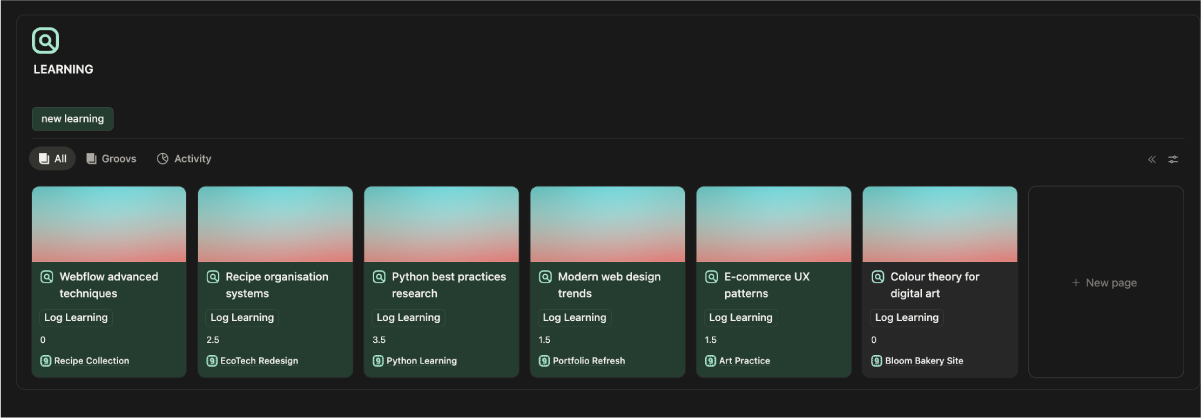
Your Learning component on the dashboard shows all your learning pages as cards, grouped by Groov. Each card shows the learning name, its linked Groov, and a Log Learning button so you can log directly from the dashboard without opening the full page.
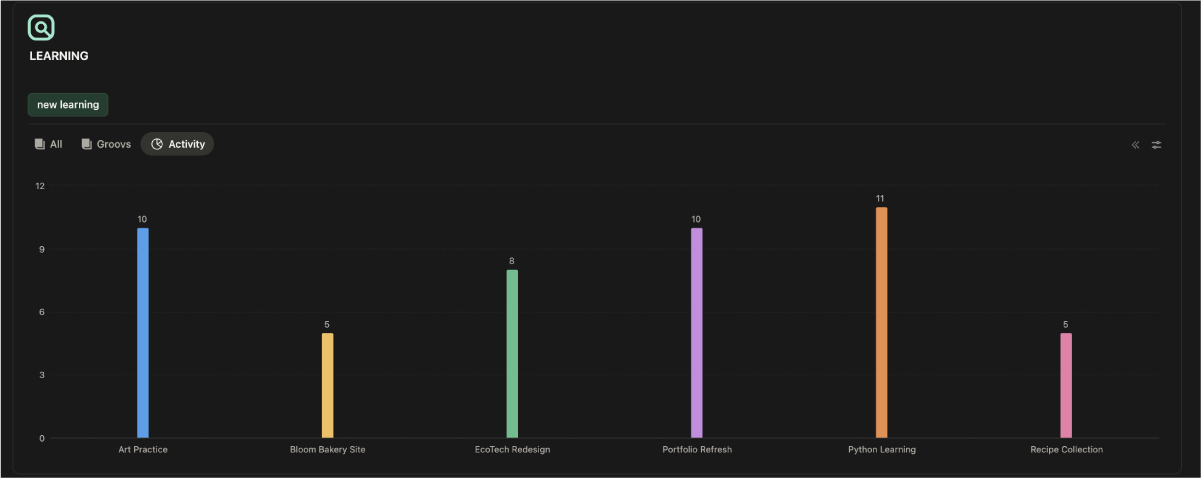
The Learning component has views across the top:
All
Shows every learning page across all Groovs
Groovs
Groups your learnings by Groov so you can see everything within each area of focus
Activity
Shows your recent logging activity
Link learnings and tasks
Learnings and Tasks can be linked to each other, which is one of the more powerful combinations in groovmint. When you're working on a task that requires research, you can link the relevant learning pages to it. The task's Learnings tab will then show only the learnings connected to that task - so when you open the task, all your research is right there alongside it.
Get the most from learnings
- One page per topic, not per session. Create one Learning page for "Python Basics" and keep logging to it over time, rather than creating a new page every time you study. Your notes build up in one place and your momentum accumulates on the same page.
- Be consistent with what counts as a log. Decide upfront what one log means for this learning - half an hour, one chapter, one resource reviewed - and stick to it. Consistency makes your momentum data trustworthy.
- Use it as a proper knowledge base. Don't just log and leave the page empty. Add your notes, paste in links, write summaries. The more you put in, the more useful it becomes when you revisit it.
- Notes and summaries